


The Last Mile Problem: Re-Thinking Modern Aerial Logistics
By Jacob Wirtzer
ParaZero Technologies Ltd.
In the critical minutes following a natural disaster, military engagement, or search-and-rescue operation, the difference between mission success and failure often comes down to one question: can you deliver the right payload to the exact location when it’s needed most?
From urban battlefields to disaster zones in complex terrains, finding logistical solutions that are adaptable, scalable, and mission-relevant remains a challenge.
In recent years, organizations across these environments have increasingly adopted drone technology into their operations. The public safety drone market alone is projected to exceed $2 billion by 2028, as drones develop from experimental devices to standard first-responder tools (Markets & Markets, 2023). Drone manufacturer DJI reported that as of 2023, rescuers using its platforms had saved more than 1,000 people (DJI, 2023). The rapid advancement of drones has given first responders, militaries and SAR operators an effective, cost-cutting advantage. Yet while UAS have proven invaluable for situational awareness and surveillance, their role in payload delivery remains constrained by limitations that have long defined traditional logistics models, most notably, reliance on large-scale transport and complicated supply chains.
As global operational envelopes evolve, there is a growing need to re-think what aerial logistics should look like. Precision and modularity are no longer optional; they are prerequisites for mission success.
Legacy Systems and Operational Gaps
When a 7.0 magnitude earthquake struck Haiti in 2010, the global humanitarian response appeared coordinated and massive: hundreds of aircraft, thousands of emergency professionals, and millions of dollars in aid flooded in (Scielo, 2021).
The logistical response followed a “hub-and-spoke” framework model: large aircraft delivered aid to a central airport, trucks moved it to depots, and helicopters handled the final leg of delivery. While this model seemed efficient and tested, serious limitations soon appeared.
Although the system included multiple distribution points, they were almost always established near makeshift landing zones where helicopters could safely land and deliver aid. Only those able to reach these areas received supplies, leaving many isolated populations without help. Bureaucratic disputes and coordination failures compounded the issue, delaying distribution while supplies sat on runways (Scielo, 2021). Vince Beiser of Wired magazine stated it best, “The most persistent systemic problem with big international aid efforts … is that no one is in charge.”

A US Army UH-60 Black Hawk helicopter flies toward a supply distribution point in Jeremie, Haiti (US SOUTHCOM 2016 )

A crammed truck tries to navigate a road partially blocked by a landslide near Pestel, Haiti, after the 14 August earthquake. ( The New Humanitarian, September 2021)
The Haiti case highlights a disconnect between delivery capacity and last-mile logistics, where the people who need aid most are often left waiting while administrative processes and modular delivery methods restrict freedom of operation.
A similar issue appears in search and rescue missions. When a lone hiker was injured in northern Arizona, rescuers located him quickly, but darkness and weather considerations prevented immediate aerial extraction. To solve the problem, paramedics were hoisted in overnight, rendering the solution both risky and labor-intensive (FireRescue1, 2021). Although helicopters have high payload capacity, their operational costs, crew requirements, and airspace constraints can limit their overall effectiveness in last mile logistics.
With modern geolocation and SAR tools, it is not the “search” that proves difficult, but the “last mile”, where delivering critical aid effectively can be the difference between life and death.
The Evolving Battlefield
In military contexts, this gap becomes more pronounced. Modern battlefields create dynamic challenges that antiquated thinking cannot solve. John J. Pershing’s WWI motto still rings true today: “Infantry wins battles, logistics wins wars.”
Following Hamas’ attack on Israel in October 2023, the Israel Defense Forces prepared for a large-scale ground offensive. Gaza’s dense urban terrain demanded tailored logistics. One example was the way blood transfusions reached forward-operating units. Since blood must be kept refrigerated, armored vehicles store the reserve supply on the back lines until mobile trauma teams require it.
Over 10,000 soldiers have been injured throughout the conflict, with 14% classified as moderate to severe (Ynetnews, 2023). Coordinating casualties, trauma teams, and blood supplies wasted critical minutes, often determining severity of injury or even survival. Furthermore, unused blood had to be replaced every 48 hours, requiring logistic convoys to be sent to switch the blood, exposing soldiers to ambushes and mechanical issues. The IDF’s experience reflects a larger truth: as warfare becomes decentralized and asymmetric, so too must logistics. The future of combat resupply is not heavier. It is smarter, stealthier, and faster.
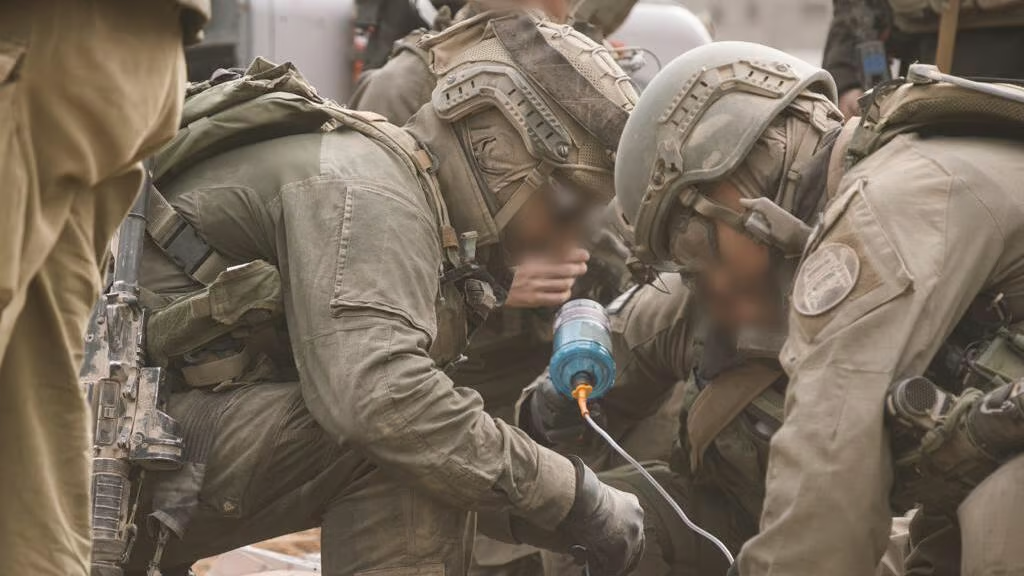
IAF Medivac unit with wounded troops in Gaza (Photo: IDF Spokesperson Unit)
Over 10,000 soldiers have been injured throughout the conflict, with 14% classified as moderate to severe (Ynetnews, 2023). Coordinating casualties, trauma teams, and blood supplies wasted critical minutes, often determining severity of injury or even survival. Furthermore, unused blood had to be replaced every 48 hours, requiring logistic convoys to be sent to switch the blood, exposing soldiers to ambushes and mechanical issues. The IDF’s experience reflects a larger truth: as warfare becomes decentralized and asymmetric, so too must logistics. The future of combat resupply is not heavier. It is smarter, stealthier, and faster.
Across humanitarian, SAR, and military domains, a pattern emerges: the greatest logistical failures occur not from lack of resources, but from inability to deliver them precisely when and where needed. Trucks, helicopters, and convoys are powerful yet inflexible. What is needed is not just a re-thinking of logistics doctrine but a retooling of the systems themselves. This growing realization sets the stage for next-generation aerial delivery systems.
The DropAir Solution
DropAir was engineered to solve the critical “last-mile” delivery problem. The smart, compact aerial delivery system was designed for cross-platform integration across commercial and military-grade UAS, allowing seamless incorporation into existing fleets. Developed by ParaZero, DropAir enables precise payload deliveries with safety, affordability, and adaptability in mind.
Whether providing ammunition and communications gear to patrol units under fire, delivering a medical kit to a stranded hiker, or supplying food and water after a natural disaster, DropAir transforms any capable drone into a logistics asset.
By utilizing ParaZero’s patented technologies, DropAir achieves accuracy from altitudes of hundreds of meters. The modular capsule supports small-medium payloads and can be configured for larger cargo, as long as the drone’s MTOW (max take-off weight) allows. Built intentionally as a single-use device, it keeps costs low and eliminates the extra logistical step of retrieval, a pain point often cited.

X2 DropAir Packages Mounted on HEVEN H100
The DropAir Solution
The blood delivery use-case directly informed DropAir’s development, and the IDF has already begun integrating the system into operations (YnetGlobal, 2025). During testing, IDF doctors were concerned that blood transfusions might be damaged by G-forces from parachute deployment and impact. Research later confirmed the blood remained unchanged on a microbiological level, validating it for immediate field use.
This test served as a key proof of concept, demonstrating that DropAir can safely deliver fragile payloads like blood as well as more robust cargo. During recent operational exercises, DropAir successfully executed 50 consecutive payload drops with pinpoint accuracy. The success of these trials underscores a larger shift in logistics philosophy, evolving from bulk movement to precision deployment.
Conclusion
As unmanned systems continue to advance, the ability to precisely and autonomously deliver mission-critical payloads will define the next generation of aerial logistics. Legacy platforms such as transport aircraft and convoys will retain importance, but logistics doctrine must now adapt to evolving operational demands.
DropAir stands as a tested, field-ready innovation, not just as a concept, but as a capability. With operational integration, validation, and scalable adaptability, DropAir is transforming how we think about emergency response, supply-chain agility, and battlefield logistics.
To match the pace of modern threats and challenges, delivery systems must be as agile as the teams they serve, as strategic as their mission planning, and as reliable as the personnel who depend on them. Precision is no longer a luxury—it is a necessity.

